
Finding the sweet spots systematically
AI, and large language models in particular, promise productivity gains across financial institutions. Turning that promise into results needs a systematic approach to opportunities rather than isolated pilots.
We approach the problem from two angles. First, assessing each step of the risk process chain against key AI capabilities shows where AI can deliver value fastest. Second, a review of published AI applications provides practical examples to start from, identifies the methods that work, and indicates how mature each area is.
What the evidence shows
AI opportunity is everywhere in the risk function
We found documented use cases in every risk type, from credit and market risk to operational, compliance, model and climate risk.
A surge since 2023
Documented uses rose sharply since 2023. Large language models account for much of the recent growth, but classical machine learning remains a significant contributor.
Text based processes create LLM opportunities
Wherever unstructured, text-based information is at the core of the process, LLMs can improve process efficiency and quality.
Model risk is the unexpected newcomer
Publications related to model risk have increased consistently for years and contribute almost 40% in 2026. Not only are model and validation documents an ideal opportunity for LLM application; models are used in the validation process, and to explain other AI models.
Machine learning in credit, financial crime and fraud
These areas combine large data sets, clear objectives and a long history of quantitative methods. Financial crime and fraud show the highest maturity.
Traded risk uses a portfolio of approaches
From regime detection to wrong-way risk analysis, there are many applications of AI in the context of market and counterparty risk. Market generators allow targeted stress scenario generation, and pricing approximators mitigate compute constraints.
Use cases by risk type and implementation stage
Use cases by risk type
Use cases by implementation stage
Read our study
This high-level study breaks down the use cases by risk type, the main use case categories in each risk type, and the benefits AI delivers. Confirm your email address to download the document.
From the risk function to the use case and underlying study
The downloadable document provides detail to the risk type level. In workshops and client engagements, we drill down into each use case category, identifying representative key use cases, modelling approaches, benefits and challenges, and discussing the underlying studies which are most relevant to your situation.
-
Risk Function
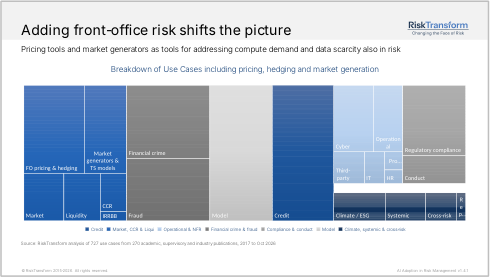
Breakdown of use cases
-
Risk Type Family
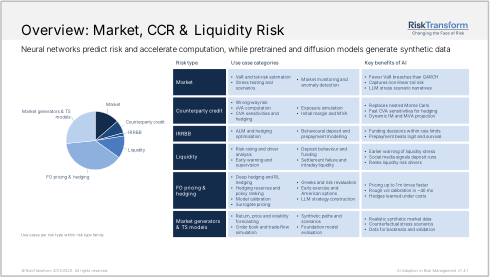
Use case summaries and benefit drivers
-
Risk Type
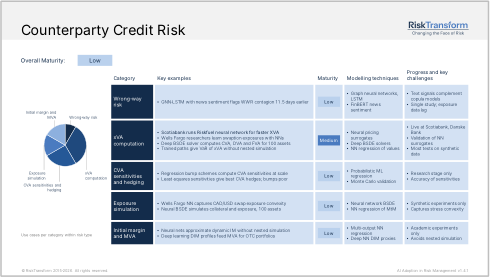
Representative use cases, modelling techniques, benefits and challenges, maturity
-
Use Case
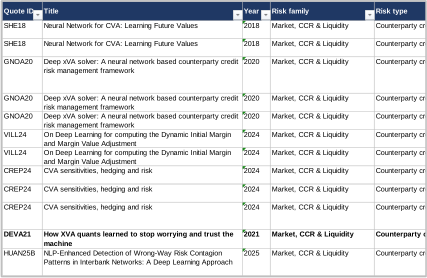
Use case inventory with link to the underlying source
-
Source
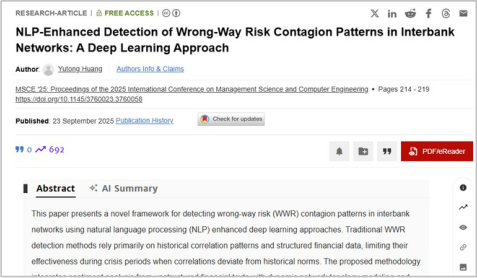
Linked source document
Taking it further
Discuss the results with us
An AI adoption workshop uses the full study to find and prioritise the opportunities that fit your organisation, and can drill down into many of the underlying papers.
Follow our research
New articles and studies on AI, model risk and FRTB.
AI & Model Risk
Our view, the questions we help with, and our services.